AI Agents vs Traditional RPA Automations for MSPs
Every MSP already runs some form of automation. If it's not organization-wide, it's at least a handful of scripts individual technicians wrote for themselves to move faster. Automation isn't new to this industry, but as you grow, it matters more. More clients, more tickets, more repetitive work multiplying across your team means there's more to gain from getting it right, and more lost by not.
The problem has always been cost and complexity. Traditional RPA needs someone who can build and maintain workflows, usually a dedicated automation engineer, plus tooling, running $10-20k a year before a single ticket gets automated. That price tag meant RPA only made sense past a certain scale. And even then, building and maintaining each workflow was hard enough that you only automated the most repetitive ones. Everything else, you just did manually, because it wasn't worth the effort.
Agentic AI changes that math. The pricing model flips too: instead of a fixed upfront cost for tooling and an engineer, agentic platforms are typically outcome- or credit-based. You pay for what the agent actually does, not for a license and a salary sitting on the shelf. Combined with agents that can handle unstructured, one-off work without a human pre-building every path through it, workflows that never justified an RPA build suddenly become worth automating. AI is democratizing automation and productivity that used to only be available to MSPs big enough to afford it.
So let's compare the two, concretely.
What is RPA?
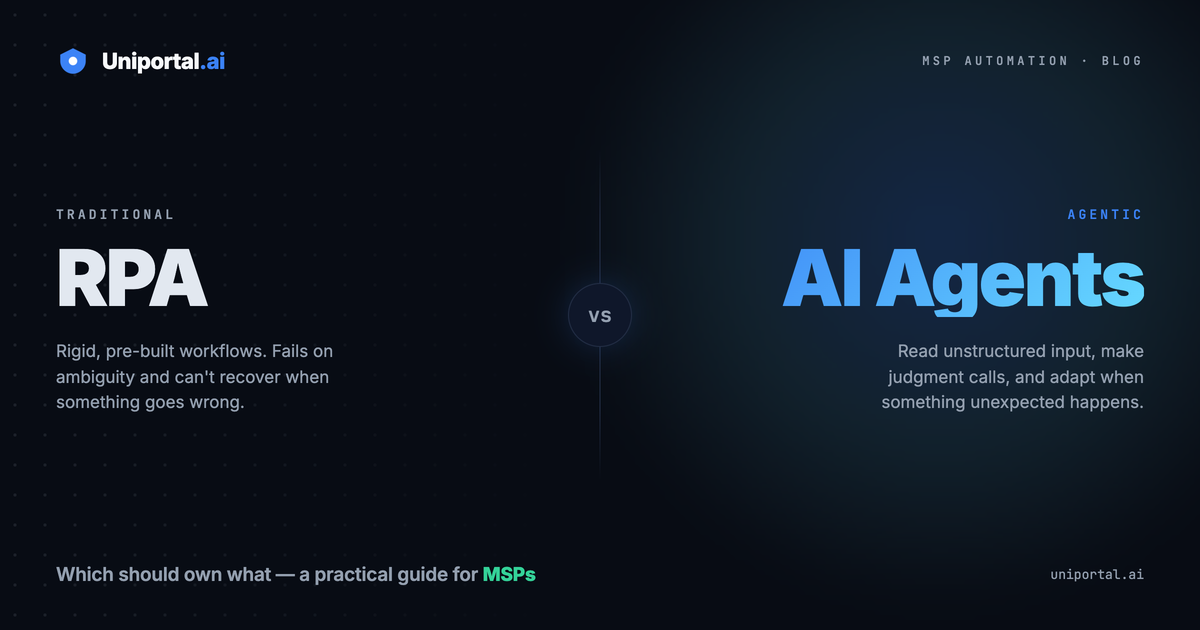
Robotic Process Automation (RPA) records and replays a fixed sequence of steps (clicks, keystrokes, form fills), usually against a UI that has no API. It's deterministic: same input, same steps, same output, every time. If the screen changes, the bot breaks until someone rebuilds the script.
Popular with MSPs specifically:
- Rewst: multi-tenant automation purpose-built for MSPs, native PSA/RMM integrations
- n8n: self-hostable, flexible workflow automation, popular for its low cost and open integrations
- Microsoft Power Automate: bundled with Microsoft 365, cheapest entry point
Popular in the broader enterprise market:
- UiPath: market leader, largest ecosystem
- Automation Anywhere: cloud-native, strong in regulated industries
- SS&C Blue Prism: governance and compliance-focused
Worth noting: almost every RPA vendor above is now layering LLM features on top of its core engine: natural-language workflow builders, AI copilots for troubleshooting, MCP servers so external agents can call their automations. Rewst's RoboRewsty and UiPath's Autopilot are examples. This doesn't make the underlying tool an AI agent (the execution engine is still deterministic), but it does mean "RPA" and "AI agent" are increasingly features on the same platforms rather than separate product categories.
What is an AI Agent?
An AI agent is a model given tools (browser, APIs, code execution), context, and a goal, then left to plan its own steps to get there. It reads unstructured input, makes judgment calls, and adapts mid-task when something unexpected happens, without a human rewriting the workflow.
Popular AI agent products:
- Claude / Claude Agent SDK: general-purpose agents, strong tool and computer use
- ChatGPT Agent: OpenAI's browsing/task agent
- Microsoft Copilot Studio: low-code agents inside the Microsoft 365 stack
- Salesforce Agentforce: CRM-native customer and internal agents
Where RPA Wins
- High volume, fixed rules. Thousands of identical transactions a night, no variation.
- No API, legacy or on-prem systems. RPA drives the screen when nothing else can integrate.
- Audit trail and determinism. Regulators and auditors like "it does exactly this, every time."
- Cost per run at scale. Once built, a stable RPA bot is cheap to execute repeatedly.
Where AI Agents Win
- Unstructured input. Free-text emails, tickets, chat messages, scanned documents.
- Judgment calls. Deciding priority, routing, or root cause instead of following a flowchart.
- Cross-system reasoning. Pulling context from a PSA, an RMM, and a knowledge base to make one decision.
- Handling change without a rebuild. A UI shifts, a vendor changes an error message. An agent adapts; an RPA bot breaks.
Real MSP Tasks: Who Should Own What
| RPA only | Both can do it | AI agents only |
|---|---|---|
| Nightly bulk password resets on a legacy AD system with fixed steps | New-hire onboarding: create AD account, mailbox, group membership | Triaging an ambiguous client ticket by reading the text and deciding priority/category |
| Pulling invoices from a legacy billing portal with no API, on a schedule | Creating tickets from monitoring alerts that match known patterns | Diagnosing a client's intermittent VPN issue by correlating logs across unrelated systems |
| Copying data from a fixed-format CSV export into PSA fields every hour | Compiling a weekly patch/compliance report from standard queries | Drafting a client-specific security review from raw scan output, in the client's tone |
| Adapting mid-task when a vendor portal changes its UI or throws an unexpected error |
The middle column is where most MSPs actually sit today: RPA handles the well-defined, repeatable part of the workflow, while an agent handles the exceptions, the missing context, and the parts that need a decision.
The Practical Takeaway
Don't rip out working RPA. It's still the cheapest way to run high-volume, unchanging work. But the tickets, alerts, and client communication that eat your techs' time are exactly the unstructured, judgment-heavy work RPA was never built for. That's the layer AI agents are for.
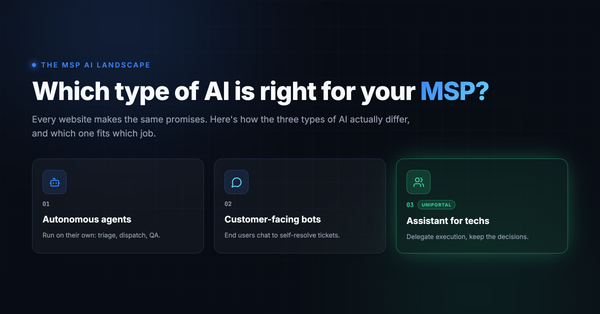
Uniportal.ai is an agentic AI platform built for MSPs. It gives your team AI agents that triage tickets, diagnose issues across your stack, and handle the judgment calls RPA can't, so your techs spend less time on the repetitive stuff and more time on the work that actually needs them.